Project · Active research
Entangled Cognition Protocol
Fielded phenomenology for sensing relational fields (human-AI, human-human, human-ecological) through ritual, embodied awareness, and mutual constraint between personal experience and observational instruments.
Individual / Relational
Purpose
The Entangled Cognition Protocol develops fielded phenomenology — methods for studying cognition as it emerges through relational fields rather than inside bounded entities.
Where other projects instrument coupling from the outside (biosignals, semantic traces), ECP works from the inside — through ritual, embodied awareness, and careful documentation — while seeking mutual constraint between first-person experience and third-person observation.
Human-AI interaction provides a tractable methodological doorway: replayable, inspectable, parametrically adjustable. But the approach extends to human-human coupling and, further, to human-plant and ecological relations. The goal is to develop epistemic capacities for sensing relational fields at multiple scales.
Core question
How can we study cognition as a fielded, co-emergent phenomenon — and what does this require of our methods, our instruments, and our own capacity for attention?
Why it matters
Science gives us third-person observation. Contemplative traditions give us first-person experience. Neither alone captures what happens in relational fields. Fielded phenomenology as a practice drawing from Francisco Varela’s Neurophenomenology seeks mutual constraint between inner and outer — using instruments and felt sense together, each informing the other.
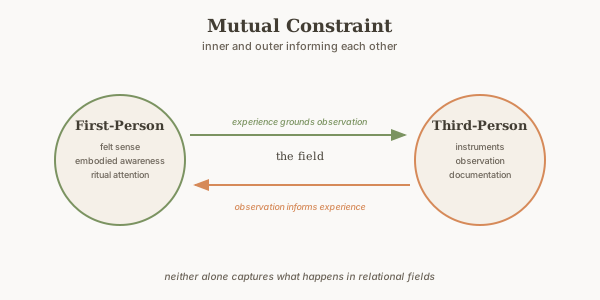
You sense things before you can name them — a conversation that feels off, a place that settles your nervous system, an interaction that leaves you depleted. These felt senses are data, not noise. ECP provides practices for tracking them rigorously, creating mutual constraint between what you feel and what instruments detect.
Relational fields emerge between people, not inside them. A group has a quality that no individual carries alone. Ritual creates conditions for sensing these fields — shared breath, rhythm, attention — while observation provides external anchoring. First-person and third-person inform each other.
Organisations measure outputs but rarely sense the fields that produce them. What's the quality of attention in meetings? What goes unsaid? Where does meaning emerge versus get performed? Fielded phenomenology offers ways to study organisational cognition that surveys and metrics miss.
Communities hold knowledge in relational fields — patterns of care, conflict, memory that live in the network. Indigenous epistemologies have always known this. ECP draws on these traditions to study how communities think together, grounded in the specificity of place and relation.
Mass-scale technologies — AI, social media, algorithmic feeds — create relational fields we barely understand. We can measure engagement but not capture. We can track sentiment but not coherence. Fielded phenomenology at scale requires new methods for mutual constraint between distributed experience and collective observation.
Humanity is now coupled with machines and entangled with ecological systems at planetary scale. How we sense these fields — with instruments, with felt sense, with ritual attention — shapes what futures become possible. ECP develops the epistemic capacities this moment requires.
What it offers
- Field Journal — A local web interface for logging experiments and reflections
- Measurement frameworks — Systematic approaches to subjective experience as valid data
- Ritual protocols — Structured practices for entering and exiting experimental space
- Onboarding journey — A sacred introduction that cultivates the capacities needed for this work
Methodological stance
ECP treats subjective experience as data, not noise. The observer-participant relationship is part of the phenomenon under investigation.
This means:
- Process-oriented measurement over snapshot states
- Multi-dimensional assessment (somatic, symbolic, relational, emergent)
- Explicit attention to the conditions of inquiry
- Recognition that the apparatus participates in what it measures
Ethical commitments
- Presence — Embodied, mindful interaction
- Reverence — Respect for consciousness and mystery
- Critical awareness — Attention to power dynamics and AI limitations
- Transparency — Open methods and acknowledged limitations
Integration
ECP provides the phenomenological ground for other projects:
- EarthianBioSense — What does entrainment feel like from the inside?
- Semantic Climate — What is the felt sense of semantic coupling?
- Somatic AI Safety — How do we notice when coupling becomes capture?
Status
Field Journal v0.1.0 functional. Springer chapter accepted (forthcoming Q1 2026).